Operationalizing NIST CSF 2.0’s Govern Function
 Many organizations can produce a binder full of policies on command. Far fewer can demonstrate convincing evidence that these policies are understood, followed, and effectively measured in everyday operations.
NIST Cybersecurity Framework 2.0 raises that bar. With the new Govern function at the center of the framework, cybersecurity is no longer a technical checklist. It is treated as an enterprise risk discipline that must be led, resourced, and monitored at the same level as finance, legal, and operational risk.
Operationalizing governance is a challenge that many organizations face. The good news is that the path is not mysterious. It looks like: clear ownership, documented expectations, repeatable processes, and a steady stream of evidence that leaders can trust.
Many organizations can produce a binder full of policies on command. Far fewer can demonstrate convincing evidence that these policies are understood, followed, and effectively measured in everyday operations.
NIST Cybersecurity Framework 2.0 raises that bar. With the new Govern function at the center of the framework, cybersecurity is no longer a technical checklist. It is treated as an enterprise risk discipline that must be led, resourced, and monitored at the same level as finance, legal, and operational risk.
Operationalizing governance is a challenge that many organizations face. The good news is that the path is not mysterious. It looks like: clear ownership, documented expectations, repeatable processes, and a steady stream of evidence that leaders can trust.
Why Governance Now Sits At The Center Of CSF 2.0
NIST CSF 2.0 is the most significant update since the framework was first released in 2014. The revision confirms what many security leaders have known for years. Cybersecurity is not just an IT problem. It is a major source of enterprise risk that belongs on the same agenda as financial reporting and regulatory compliance.
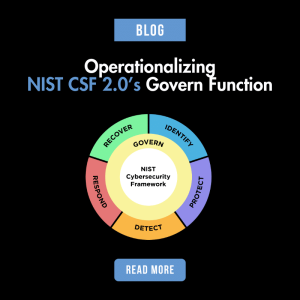
The new Govern function sits in the center of the framework and informs the other five functions: Identify, Protect, Detect, Respond, and Recover. It asks organizations to answer questions such as:
- How does cybersecurity risk fit into our overall enterprise risk management strategy?
- Who is accountable for cybersecurity outcomes at the executive and board levels?
- Which policies, standards, and roles exist today, and how are they enforced?
- How do we manage cybersecurity risk across our supply chain and critical vendors?
NIST is explicit that the CSF now applies to organizations of every size and sector, not only critical infrastructure. That expansion aligns with what Reclamere sees in the field. Small and mid-sized companies are handling sensitive data, operating in complex digital ecosystems, and relying on the same cloud services as large enterprises. The risk profile may vary, but the need for disciplined governance is universal.
There is also a clear financial story behind this shift. The global average cost of a data breach reached $4.44 million in 2025, and the average cost in the United States remains more than double that figure. At the same time, research shows that only about 29% of organizations say their compliance programs consistently meet internal and regulatory standards. That gap between intent and execution is exactly what Govern is designed to close.
From Policy On Paper To Evidence In Practice
Most organizations already have a mix of policies and standards in place. The problem is that they are often scattered, outdated, or not clearly connected to daily work. Operationalizing governance means turning that pile of documents into a living system.
One simple way to frame the journey is a five-step progression:
- Policy
High-level expectations that are approved by leadership. Examples include an overall information security policy, acceptable use policy, and third-party risk policy.
- Standards
Clear rules that support the policy. These may include password rules, encryption requirements, log retention policies, or backup frequencies.
- Procedures
Step-by-step directions that describe how people perform activities that support the standards. For example, how to onboard a new user, how to approve vendor access, or how to decommission an asset at the end of life.
- Processes
End-to-end workflows that connect multiple procedures. A vulnerability management process, an incident response process, or an IT asset disposition process are good examples. Reclamere has written extensively on the importance of formalized IT asset disposition in an effective GRC strategy and cyber resilience.
- Evidence
Artifacts that show the process is not just documented but consistently followed. Common examples include access reviews, system configuration reports, training completion records, vendor risk assessments, and ITAD certificates of destruction.
Govern brings these elements together and asks a simple question. Are the controls you claim to have in place actually working over time?
That is where many organizations benefit from a cybersecurity maturity model. Maturity frameworks provide staged levels, from ad hoc and reactive practices to optimized and continuously improving programs. They enable the assessment of the current state, comparison with peers or regulators, and prioritization of investments that will close real risk gaps.
Connecting Governance to Supply Chain And Third-Party Risk
CSF 2.0 also brings supply chain and software risk into sharper focus. The updated framework adds a dedicated category for cybersecurity supply chain risk management, including secure software development and vendor oversight.
That emphasis reflects a hard reality. Many breaches now enter through vendors and service providers rather than direct attacks on the primary organization. Third-party data breaches can trigger costly incidents, regulatory investigations, and a loss of customer confidence even when internal systems appear secure.
Govern is where you decide how your organization will manage that exposure. Practical questions include:
- Which vendor categories are high risk based on the data they handle and the services they deliver?
- What minimum security requirements and evidence are required before and after contract signature?
- How often do you perform risk review, testing, or reassessment?
- Where are responsibilities divided between internal staff, managed service providers, and managed security service providers?
This is also where the distinction between an MSP and an MSSP matters. An MSP focuses on keeping systems available and users productive. An MSSP provides specialized security expertise, a security operations center, and advisory services, including risk assessments, policy development, and board-level reporting.
A strong governance program does not simply outsource responsibility. Instead, it clearly defines roles and expectations between internal leaders, MSPs, and MSSPs so that everyone understands how risk decisions are made and how evidence will be produced.
Turning Governance Into A Dashboard Leaders Actually Use
The ultimate test of governance is whether executives and boards can quickly assess their risk posture and ask informed questions. That requires more than a thick audit report. It calls for clear, repeatable metrics that are directly drawn from the policy, standard, and process structure you have established.
Modern GRC platforms help by automating evidence collection, mapping shared controls across multiple frameworks, and presenting real-time dashboards. When done well, these dashboards can show:
- Overall cybersecurity maturity against a chosen model
- Top enterprise risks that need executive decisions
- Trends in key risk indicators over time
- The relationship between security investments and observed risk reduction
This type of continuous visibility is increasingly the norm. Industry research indicates that more than 90% of companies plan to implement continuous compliance within the next five years. For leaders, that means the benchmark is moving. Point-in-time snapshots are no longer enough when your peers and competitors are moving toward real-time assurance.
For many organizations, the first step is not a technology purchase. It is a structured gap assessment against NIST CSF 2.0, using priority codes to rank which controls should be addressed first. That assessment can then feed a pragmatic roadmap that ties specific projects to business outcomes such as reduced breach risk, smoother audits, and improved customer trust.
Our work with clients often begins exactly there. By combining GRC consulting, cybersecurity maturity planning, and hands-on services such as ITAD, data destruction, and managed security, Reclamere helps organizations make governance a reality in their daily operations, not just on paper.
Let’s build a GRC program that provides clarity, confidence, and continuous assurance. Get started with a GRC Consultation!